By Mark Williams
After a slight reshuffle, Gunth passes the baton on to a new team of
hitchhikers. This time, Mark attempts to pin down that invisible ubiquitous
threat, radiation. - with footnotes!
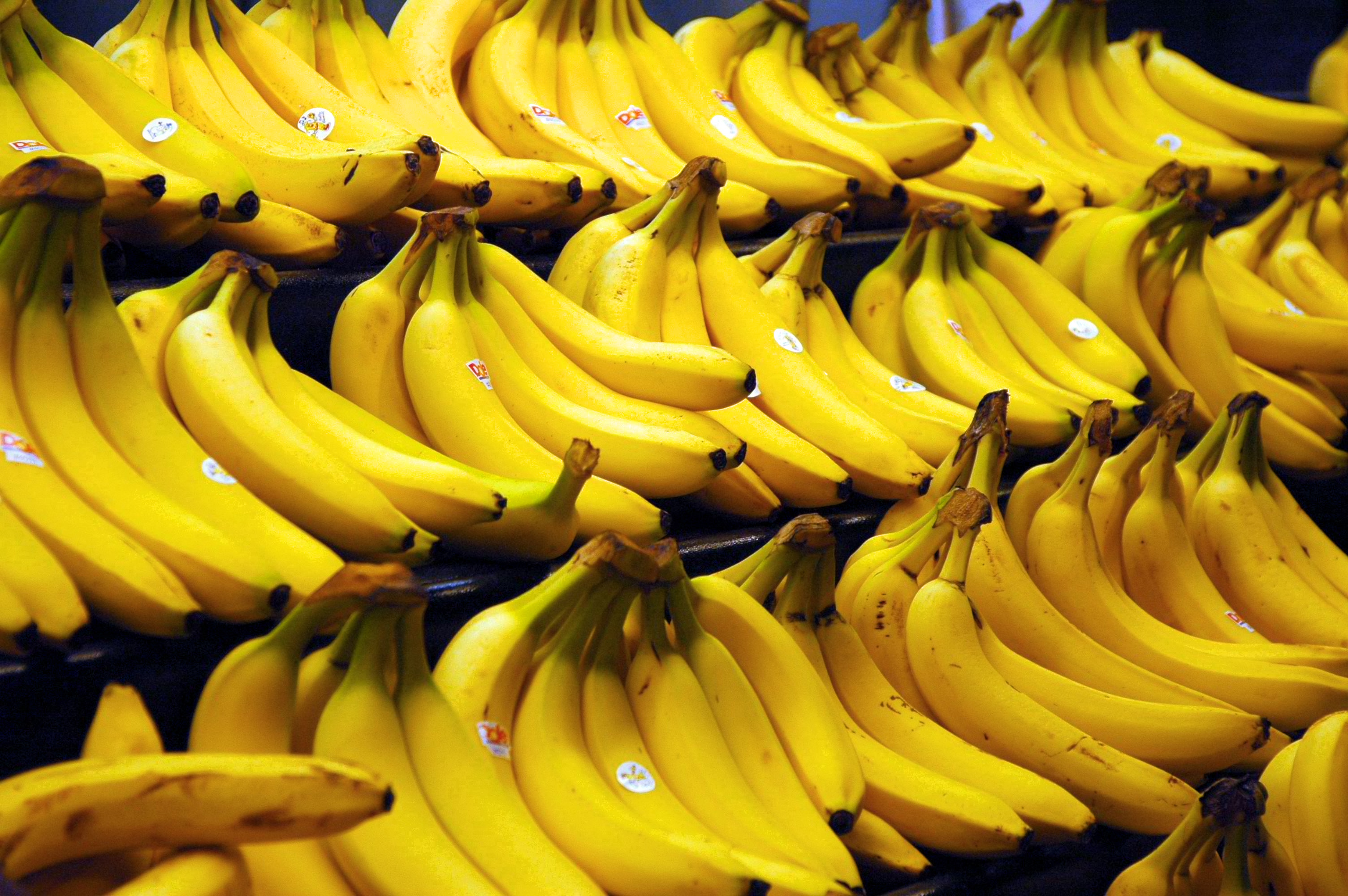
 Today, whilst checking my own ionising radiation exposure, I was reminded of when I visited a school to talk about radiotoxicity. I borrowed a friend’s outreach exercise, which uses the banana equivalent dose (BED) as a visual way of depicting radiation exposure using one of your five-a-day. After a short description of a bananas radioactive content, students were asked questions such as, what is the BED for taking a plane journey from London to New York? What about doing nuclear research for a year? What about living in the south-west of England for a year[1]?
One banana contains, on average, about 0.5 g of potassium. Right now you contain about 160 g of potassium which, along with sodium, control the electric potential across the synapses of every nerve cell in your body. However, potassium contains ~117 ppm of a radioactive isotope, potassium-40. That gives us 15.5 Bq per banana[2], Becquerels are the SI (or standard) units for activity. One Becquerel is equivalent to one decay per second. (Oh, and before you throw all your bananas out, half a pint of orange juice contains about 0.5 g of potassium too, so carries roughly the same activity.)[3]
 The point of this yard-stick is that it highlights the ubiquity of ionising radiation. It is everywhere, and everyone is irradiated all the time. Your exposure is affected if you fly a lot, it will change depending on your local geology, and it will change if you work with radioactive material. So what are we exposed to on average in the UK? And how might this change if say, we lived near a recent nuclear incident zone? The average Brit has an annual exposure to ionising radiation comprised of 84.5% natural background radiation[4], 15% medical[5], 0.2% occupational and 0.2% from nuclear fallout[6], the remainder (<0.1%) is from discharge[7]and consumer products.[8]At this point it may be helpful to relate ionising radiation to UV-rays, that is the radiation we receive from the sun (and certain beds) that both age and burn the skin at high doses, but is also an important factor in helping to prevent skeletal disease and vitamin D deficiency.
Our background dose, radiation from our geology, food, atmosphere and the furthest reaches of space, has been present a lot longer than we have; our bodies have evolved to handle this steady dose. So what about an elevated exposure? What about Fukushima? Currently, your lifetime risk of getting cancer in the UK is approximately 45% for men, and it’s about 5% lower for women.[9]In Japan it’s 41% for men, but for those from the Fukushima province – lifetime risk is increase by 1%[10], totalling ~41.4% for men. This is certainly significant, but it is probably lower than most would have expected. For an excellent analysis of nuclear accidents in context, read our previous article.
This blog has previously stated the importance of demystifying the jargon, highlighting that a misunderstanding from poor communication can lead to feelings of a separation from science. The BED is one way we can try to do this, it is not an official scientific unit of measure, but it can help to explain the ubiquity of radiation - to highlight that its presence in life is normal.
So, what do you think? Feedback I got from the school kids was pretty mixed, some (OK, most) went away talking about telling their parents to stop buying bananas… I’ll explain it better next time, I thought.
[1]For more information on the differences in exposure dependent on where you live in the U.K, see this article: http://www.sciencedirect.com/science/article/pii/S0265931X14002598
[2] We start with 0.5 g of potassium, but since we only consider the radioactive K-40, we multiply first by 0.000117 and then by 1/40th of a mole. 1.25 billion years (the half-life of K-40) is 3.9446x10¹⁶ seconds, so we write:
decays per second (Bq) = 6.1x10¹⁷ / 3.9446x1016 = 15.5 Bq.
[3] 1 Becquerel is 1 disintegration/decay per second. The Grey is the absorbed dose, and the Sievert details the equivalent dose, in other words the actual dose a person receives. Having these different definitions is important when assessing our radiation exposure, but the conversion is not simple, we must know the type of radiation as well as the locality (a banana ingested, inhaled(?!) and held, all carry the same Becquerel but very different Sievert values).
[4]Background radiation comes from space, namely stars, like our sun.
[5]X-rays are a form of high energy radiation, and therefore ionising. CT scans also use x-rays, but in (much) larger quantities. These operations are localised and only effect the organ being examined. See herefor a nice infographic
[6]There have been many tests of nuclear weapons across the globe; these release radioactive material into the environment.
[7]The UK reprocesses its nuclear waste. The effluent is treated and then discharged into the Irish Sea.
[8]All of this data has been taken from J S Hughes et al. 2005 Review of the radiation exposure of the UK population
[9]Source: http://www.cancerresearchuk.org/cancer-info/cancerstats/incidence/risk/statistics-on-the-risk-of-developing-cancer
[10]WHO: http://apps.who.int/iris/bitstream/10665/78218/1/9789241505130_eng.pdf
Today, whilst checking my own ionising radiation exposure, I was reminded of when I visited a school to talk about radiotoxicity. I borrowed a friend’s outreach exercise, which uses the banana equivalent dose (BED) as a visual way of depicting radiation exposure using one of your five-a-day. After a short description of a bananas radioactive content, students were asked questions such as, what is the BED for taking a plane journey from London to New York? What about doing nuclear research for a year? What about living in the south-west of England for a year[1]?
One banana contains, on average, about 0.5 g of potassium. Right now you contain about 160 g of potassium which, along with sodium, control the electric potential across the synapses of every nerve cell in your body. However, potassium contains ~117 ppm of a radioactive isotope, potassium-40. That gives us 15.5 Bq per banana[2], Becquerels are the SI (or standard) units for activity. One Becquerel is equivalent to one decay per second. (Oh, and before you throw all your bananas out, half a pint of orange juice contains about 0.5 g of potassium too, so carries roughly the same activity.)[3]
The point of this yard-stick is that it highlights the ubiquity of ionising radiation. It is everywhere, and everyone is irradiated all the time. Your exposure is affected if you fly a lot, it will change depending on your local geology, and it will change if you work with radioactive material. So what are we exposed to on average in the UK? And how might this change if say, we lived near a recent nuclear incident zone? The average Brit has an annual exposure to ionising radiation comprised of 84.5% natural background radiation[4], 15% medical[5], 0.2% occupational and 0.2% from nuclear fallout[6], the remainder (<0.1%) is from discharge[7]and consumer products.[8]At this point it may be helpful to relate ionising radiation to UV-rays, that is the radiation we receive from the sun (and certain beds) that both age and burn the skin at high doses, but is also an important factor in helping to prevent skeletal disease and vitamin D deficiency.
Our background dose, radiation from our geology, food, atmosphere and the furthest reaches of space, has been present a lot longer than we have; our bodies have evolved to handle this steady dose. So what about an elevated exposure? What about Fukushima? Currently, your lifetime risk of getting cancer in the UK is approximately 45% for men, and it’s about 5% lower for women.[9]In Japan it’s 41% for men, but for those from the Fukushima province – lifetime risk is increase by 1%[10], totalling ~41.4% for men. This is certainly significant, but it is probably lower than most would have expected. For an excellent analysis of nuclear accidents in context, read our previous article.
This blog has previously stated the importance of demystifying the jargon, highlighting that a misunderstanding from poor communication can lead to feelings of a separation from science. The BED is one way we can try to do this, it is not an official scientific unit of measure, but it can help to explain the ubiquity of radiation - to highlight that its presence in life is normal.
So, what do you think? Feedback I got from the school kids was pretty mixed, some (OK, most) went away talking about telling their parents to stop buying bananas… I’ll explain it better next time, I thought.
[1]For more information on the differences in exposure dependent on where you live in the U.K, see this article: http://www.sciencedirect.com/science/article/pii/S0265931X14002598
[2] We start with 0.5 g of potassium, but since we only consider the radioactive K-40, we multiply first by 0.000117 and then by 1/40th of a mole. 1.25 billion years (the half-life of K-40) is 3.9446x10¹⁶ seconds, so we write:
decays per second (Bq) = 6.1x10¹⁷ / 3.9446x1016 = 15.5 Bq.
[3] 1 Becquerel is 1 disintegration/decay per second. The Grey is the absorbed dose, and the Sievert details the equivalent dose, in other words the actual dose a person receives. Having these different definitions is important when assessing our radiation exposure, but the conversion is not simple, we must know the type of radiation as well as the locality (a banana ingested, inhaled(?!) and held, all carry the same Becquerel but very different Sievert values).
[4]Background radiation comes from space, namely stars, like our sun.
[5]X-rays are a form of high energy radiation, and therefore ionising. CT scans also use x-rays, but in (much) larger quantities. These operations are localised and only effect the organ being examined. See herefor a nice infographic
[6]There have been many tests of nuclear weapons across the globe; these release radioactive material into the environment.
[7]The UK reprocesses its nuclear waste. The effluent is treated and then discharged into the Irish Sea.
[8]All of this data has been taken from J S Hughes et al. 2005 Review of the radiation exposure of the UK population
[9]Source: http://www.cancerresearchuk.org/cancer-info/cancerstats/incidence/risk/statistics-on-the-risk-of-developing-cancer
[10]WHO: http://apps.who.int/iris/bitstream/10665/78218/1/9789241505130_eng.pdf
Today, whilst checking my own ionising radiation exposure, I was reminded of when I visited a school to talk about radiotoxicity. I borrowed a friend’s outreach exercise, which uses the banana equivalent dose (BED) as a visual way of depicting radiation exposure using one of your five-a-day. After a short description of a bananas radioactive content, students were asked questions such as, what is the BED for taking a plane journey from London to New York? What about doing nuclear research for a year? What about living in the south-west of England for a year[1]?
[1]For more information on the differences in exposure dependent on where you live in the U.K, see this article: http://www.sciencedirect.com/science/article/pii/S0265931X14002598
[2] We start with 0.5 g of potassium, but since we only consider the radioactive K-40, we multiply first by 0.000117 and then by 1/40th of a mole. 1.25 billion years (the half-life of K-40) is 3.9446x10¹⁶ seconds, so we write:
decays per second (Bq) = 6.1x10¹⁷ / 3.9446x1016 = 15.5 Bq.
decays per second (Bq) = 6.1x10¹⁷ / 3.9446x1016 = 15.5 Bq.
[3] 1 Becquerel is 1 disintegration/decay per second. The Grey is the absorbed dose, and the Sievert details the equivalent dose, in other words the actual dose a person receives. Having these different definitions is important when assessing our radiation exposure, but the conversion is not simple, we must know the type of radiation as well as the locality (a banana ingested, inhaled(?!) and held, all carry the same Becquerel but very different Sievert values).
[4]Background radiation comes from space, namely stars, like our sun.
[5]X-rays are a form of high energy radiation, and therefore ionising. CT scans also use x-rays, but in (much) larger quantities. These operations are localised and only effect the organ being examined. See herefor a nice infographic
[6]There have been many tests of nuclear weapons across the globe; these release radioactive material into the environment.
[7]The UK reprocesses its nuclear waste. The effluent is treated and then discharged into the Irish Sea.
[8]All of this data has been taken from J S Hughes et al. 2005 Review of the radiation exposure of the UK population
[9]Source: http://www.cancerresearchuk.org/cancer-info/cancerstats/incidence/risk/statistics-on-the-risk-of-developing-cancer
[10]WHO: http://apps.who.int/iris/bitstream/10665/78218/1/9789241505130_eng.pdf