Showing posts with label Article. Show all posts

Thursday, 27 August 2015

'Mind the (nuclear skills) gap' and 'Managing new nuclear- what's new?'

We're still here! The site is undergoing some changes, including improvements to the podcasting side and some new 'nuclear crowd-sourced' posts. This is all thanks to a renewed interest from many new faces, soon to grace this here website.


First though I'd like to share some new articles!

Managing New Nuclear – what’s new?

Mind the (nuclear skills) gap

These posts confirm for me some suspicions I've long had about the nuclear industry - an impending skills gap, the requirement for non-UK investment and an industry-academia separation. Although I don't agree with everything these authors have written (perhaps an insight into my inner-scepticism) the overall impression from both is one of panicked enthusiasm.

I'd love to know what you think, post a comment below, or tweet us


Mark Williams

Wednesday, 25 February 2015

Nuclear and Society: an outsider’s perspective

A new guest blogger! This time, we have Elizabeth, an outsider with a burning curiosity for nuclear.

By Elizabeth Harper


On the 27th January, I attended a lecture entitled ‘In The Public Eye: Nuclear Energy and Society’, given by Malcolm Grimston as part of The University of Manchester’s Dalton Seminar Series. This was set to be a particularly compelling lecture because, as we all know, nuclear has something of a PR problem and there are no clearly defined ways of rectifying it. Grimston based his lecture on a book he is currently writing on society’s conceptions of nuclear and the nuclear industry, and the innumerate tensions and uncertainties that these generate.

He began the lecture by saying that the nuclear industry does not deal with the distrust and negativity surrounding it in a very constructive way; often ending up in an indecisive state of ‘rubbing hands together’ and not proactively addressing the claims made against it. He argued that this is because of the way in which ‘people’ respond to the statements released by governments and companies like EDF that aim to inform and calm people. This can be seen in the case of the Fukushima evacuations where the government wanted to quell national and international anxiety by providing ‘safe zones’ which, ironically, served to inflame ‘people’s’ fear of radiation. According to Grimston, ‘people’ react perhaps quite rationally  to the information put forward specifically regarding nuclear safety: if they are told that nuclear stations are to be made ‘even more safe’, then how safe were they before, if it is possible for safety to be improved? Through this deconstruction of what it means to be rational or irrational, he argued that the nuclear industry and nuclear experts have to perpetually navigate a minefield of semantic eggshells in fear of inadvertently worsening ‘people’s’ already apprehensive sentiments towards nuclear.

A still from little known TV animation, 'The Simpsons'. 
I use the word ‘people’ specifically with quotation marks because it was a word that cropped up time and again in Grimston’s lecture. As he progressed, his diagnosis of who or what comprised ‘people’ became increasingly problematic: ‘people’ become an homogeneous mass of all of the people who exist outside the realm of science and the understanding of nuclear that this entails. More specifically, and more importantly, Grimston casually conflated the media with the general public, suggesting that they think (be it rationally or irrationally) in the same way.

This is problematic because the media and the general public are not the same thing and they cannot be conceived of in the same way by the nuclear industry, including highly respected academics like Grimston. There is a chain of understanding that starts with industry, which passes through the media and then is consumed by the public. As a result, the media can be considered to be more powerful than the public because they are the ones who take the information given by the industry and relay it in any way that suits their own, oftentimes, reactionary, ideological or political agenda. This not only encompasses nuclear power but also information and statistics regarding immigration or benefits claimants.

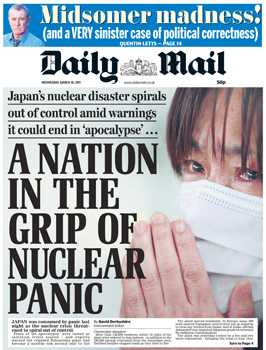
One obvious example of such an outlet is The Daily Mail, which only a few days ago published an article on how fallout and radiation from Chernobyl will affect our crops this harvest. As a result, the public read and can be swayed by headlines that scaremonger, distort facts and fuel ignorance of nuclear, producing the paranoid (ir)rational responses that Grimston discussed. I would argue, therefore, that members of the public are not to blame for their warped conceptions of radiation (amongst other nuclear problems) because they consume news headlines or Hollywood films that tell them otherwise.  If the public were not subjected to such sensationalised stories that feature in the tabloids, some of the most read newspapers in circulation and online, then it is much more likely that there would be a positive embracement of nuclear energy. As a result, the public and the media cannot be described under a vague umbrella label such as ‘people’.

This is important to not only give some credit back to an interested and interesting public who, it is becoming increasingly apparent, are misinformed and distrustful of nuclear because of the media (71% of 23,231 people from 23 countries in 2011 after Fukushima wanted to replace nuclear and coal with renewable energy sources), but also to improve the image of the nuclear industry itself.[1] It is hard to feel sympathetic for an industry where high profile academics do not critically separate the media from the public and show no active attempt to engage with the media to shine a light on the inflammatory journalism produced. Even though I, a humanities graduate, had a few of my own misconceptions addressed by the lecture, none of what Grimston said seemed to be news to the majority of the people there, evident from the knowing tutting and chortling taking place. As a result, the lecture actually ended up casting a scornful gaze on the public who through, perhaps, no fault of their own, do not know any better. This was cemented for me, when Grimston provided each case study with an example of ‘people’s’ (ir)rational reactions to safety measures; a sentence or two in the voice of ‘people’ that supposedly summed up their interpretations of various situations, mostly regarding Fukushima. As he read them out to a chuckling room, they sounded like they could have been taken for tabloid headlines. Instead of being critical of this, ‘people’, that indiscriminate homogeneous mass of everything outside of the industry, were merely mocked.

I argue that the most effective way for people who work in nuclear to ensure the future implementation and success of new nuclear is by directly addressing media headlines, for example this one from The Daily Express or this one, again, from The Daily Mail. Accept that the public have been misinformed by what they have seen and heard in the newspapers, on the television and at the cinema and confront the sensationalised stories directly. Nuclear has often been accused of secrecy and of lacking transparency, and this is becoming a self-fulfilled prophecy. I would argue that the industry must actively and publically engage in a much more open and critical dialogue and debate with the outlets and ideological apparatuses that construct what the public have come to know, understand and, ultimately, trust.   


[1] Globescan poll commissioned by the BBC, 2011.

Friday, 6 February 2015

Veritasium - "The Most Radioactive Places on Earth" review.

By Mark Williams

YouTube.com is a great place to learn some science (see end of article for a few of my favourites), here we take a critical look at a recent video on radiation.


Since its upload more than 1 month ago over 1.5 million people have already viewed Veritasium’s new video measuring radioactivity around the world. Armed with a neat Geiger counter, Derek visits many of the most infamously radioactive places on Earth: Trinity Site, Hiroshima, Fukushima and Chernobyl as well as a Uranium mine, Marie Curie’s office and the stratosphere.

The table below is based on the information provided in the video, but here I’ve kept the units at per hour, instead of per year, for each example.

Place
Approximate dose, in µSieverts per Hour
Usual background dose
0.1 to 0.2
Eating a banana
0.1 (per banana)
Peace Dome, Hiroshima, Japan.
0.3
Uranium mine
1.7
Marie Curies lab door knob
1.5
Trinitite at Trinity, US, nuclear bomb test site.
2.1
33,000 feet (The stratosphere)
2.2
Cruising altitude (long haul flight)
3.0
Chernobyl, Ukraine
5.0
Fukushima, Japan
10
Basement of Pripyat Hospital, Ukraine
2000
Permitted US radiation worker limit.
~5.7 (based on 50,000 per annum)
At the space station
~18.25 (based on 80,000 per 6 months)
Smokers lungs
~18.25 (based on 160,000 per annum)

Making ionising radiation relatable is difficult, and this video has highlighted a few important problems that arise with doing just that. For example, the Sievert does not just consider the radioactive material, but also its proximity and likely effect on the human body. This video talks about the equivalent dose, in other words the dose in a fairly homogenous field, like a city. But it also looks at the dose on a specific organ, in this case the lungs, which must consider a ‘weighting factor’ - here radioactive smoke comes into direct contact with the tissue and you have what is known as an ‘effective dose’. 

For example, smokers are much more likely to develop lung cancer than non-smokers, but being a smoker may not mean that the chance of developing other cancers is so severely increased. The dose received on the space station, also mentioned in the video, will act on the entire body.

Different radionuclides (unstable elements) give off different ionizing radiation at different rates. There are countless books (and trust me when I say countless!) defining and equating the physics of dosimetry and suitable protective measures. We are lucky to have this knowledge today as it guides our use of radioactive material within research and dictates strict commercial practices. However, its complexity makes it seem like scary jargon.

Using the banana equivalent dose, as in the video and a previous article, is at least a little bit relatable, but it doesn’t portray the complexity of ionising radiation and can, I feel, mislead our understanding. Is that a problem? Does the public need to understand the reasons behind the risk? Do people really have the time? Or are we missing something in our explanations, is there not a better more relatable parallel than bananas…


Some of my favourite YouTubers:

Veritasium - 'The science video blog from atoms to astrophysics!' These are usually about common misconceptions and debunking myths. Some videos are pretty funny, but you'll often learn something new.

VSauce - 'Our World is Amazing.' In my opinion, this is one of the most well informed channels on Youtube. Michael Stevens is able to discuss any issue, be it scientific, artistic, historical etc... and often digresses into fascinating detail.

Periodic Videos / Sixty Symbols - Brady Haron asks professors and experts from (usually) The University of Nottingham questions relating to chemistry or physics, respectively. Any regular viewer of these channels will come to adore the professors and lecturers as they explain their fields with passion.

Minute Physics - As the name suggests, this is physics heavy. But it is generally good at explaining a lot of physical concepts with a whiteboard in a short space of time.

Kurzgesagt - With one upload per month, this channel is small, but dense with interesting content. It's also occasionally hilarious.


Thursday, 15 January 2015

Radiation: The danger is in the dose.

By Mark Williams

After a slight reshuffle, Gunth passes the baton on to a new team of hitchhikers. This time, Mark attempts to pin down that invisible ubiquitous threat, radiation. - with footnotes!

Today, whilst checking my own ionising radiation exposure, I was reminded of when I visited a school to talk about radiotoxicity. I borrowed a friend’s outreach exercise, which uses the banana equivalent dose (BED) as a visual way of depicting radiation exposure using one of your five-a-day. After a short description of a bananas radioactive content, students were asked questions such as, what is the BED for taking a plane journey from London to New York? What about doing nuclear research for a year? What about living in the south-west of England for a year[1]?

One banana contains, on average, about 0.5 g of potassium. Right now you contain about 160 g of potassium which, along with sodium, control the electric potential across the synapses of every nerve cell in your body. However, potassium contains ~117 ppm of a radioactive isotope, potassium-40. That gives us 15.5 Bq per banana[2], Becquerels are the SI (or standard) units for activity. One Becquerel is equivalent to one decay per second. (Oh, and before you throw all your bananas out, half a pint of orange juice contains about 0.5 g of potassium too, so carries roughly the same activity.)[3]

The point of this yard-stick is that it highlights the ubiquity of ionising radiation. It is everywhere, and everyone is irradiated all the time. Your exposure is affected if you fly a lot, it will change depending on your local geology, and it will change if you work with radioactive material. So what are we exposed to on average in the UK? And how might this change if say, we lived near a recent nuclear incident zone? The average Brit has an annual exposure to ionising radiation comprised of 84.5% natural background radiation[4], 15% medical[5], 0.2% occupational and 0.2% from nuclear fallout[6], the remainder (<0.1%) is from discharge[7]and consumer products.[8]At this point it may be helpful to relate ionising radiation to UV-rays, that is the radiation we receive from the sun (and certain beds) that both age and burn the skin at high doses, but is also an important factor in helping to prevent skeletal disease and vitamin D deficiency.

Our background dose, radiation from our geology, food, atmosphere and the furthest reaches of space, has been present a lot longer than we have; our bodies have evolved to handle this steady dose. So what about an elevated exposure? What about Fukushima? Currently, your lifetime risk of getting cancer in the UK is approximately 45% for men, and it’s about 5% lower for women.[9]In Japan it’s 41% for men, but for those from the Fukushima province – lifetime risk is increase by 1%[10], totalling ~41.4% for men. This is certainly significant, but it is probably lower than most would have expected. For an excellent analysis of nuclear accidents in context, read our previous article.

This blog has previously stated the importance of demystifying the jargon, highlighting that a misunderstanding from poor communication can lead to feelings of a separation from science. The BED is one way we can try to do this, it is not an official scientific unit of measure, but it can help to explain the ubiquity of radiation - to highlight that its presence in life is normal.

So, what do you think? Feedback I got from the school kids was pretty mixed, some (OK, most) went away talking about telling their parents to stop buying bananas… I’ll explain it better next time, I thought.


[1]For more information on the differences in exposure dependent on where you live in the U.K, see this article: http://www.sciencedirect.com/science/article/pii/S0265931X14002598
[2] We start with 0.5 g of potassium, but since we only consider the radioactive K-40, we multiply first by 0.000117 and then by 1/40th of a mole. 1.25 billion years (the half-life of K-40) is 3.9446x10¹⁶ seconds, so we write:
decays per second (Bq) = 6.1x10¹⁷ /  3.9446x1016 = 15.5 Bq.
[3] 1 Becquerel is 1 disintegration/decay per second. The Grey is the absorbed dose, and the Sievert details the equivalent dose, in other words the actual dose a person receives. Having these different definitions is important when assessing our radiation exposure, but the conversion is not simple, we must know the type of radiation as well as the locality (a banana ingested, inhaled(?!)  and held, all carry the same Becquerel but very different Sievert values).
[4]Background radiation comes from space, namely stars, like our sun.
[5]X-rays are a form of high energy radiation, and therefore ionising. CT scans also use x-rays, but in (much) larger quantities. These operations are localised and only effect the organ being examined. See herefor a nice infographic
[6]There have been many tests of nuclear weapons across the globe; these release radioactive material into the environment.
[7]The UK reprocesses its nuclear waste. The effluent is treated and then discharged into the Irish Sea.
[8]All of this data has been taken from J S Hughes et al. 2005 Review of the radiation exposure of the UK population
[9]Source: http://www.cancerresearchuk.org/cancer-info/cancerstats/incidence/risk/statistics-on-the-risk-of-developing-cancer
[10]WHO: http://apps.who.int/iris/bitstream/10665/78218/1/9789241505130_eng.pdf


Thursday, 2 October 2014

A Comment on Nuclear Ethics

By Mark Williams


After a long absence due to us all writing up our dreaded theses, we're back! This week, Mark Williams discusses the nature of ethics within nuclear and questions whether we are doing enough within the community to educate and inform the wider public.


After a day of discussion around the ethics of nuclear, one thing seems to be clear: people want to know more about the risks, and they want dialogue with experts in the form of an open forum.Earlier this month in Manchester University’s School of Chemistry, 3 invited speakers, who have a range of expertise in energy mix economics, nuclear legislation and ethical studies, discussed their findings to a group of nuclear researchers. Rather than preaching to the choir about the benefits of nuclear, this was more of a critical assessment of how industrial and political actions can affect public perception. Dialogue ranged from the cyclical privatisation/nationalisation of energy markets to the building of another fence around Sellafield. Analysis ranged from the extensive engineered barriers to minimise radiation exposure to workers, to the perceived tarnishing impact of being born in a prefecture with a nuclear contaminant history.

Are Sellafield's security measures
symbolic of a loss of public transparency?
Take tightening security at Sellafield, for example; “anywhere with an electrified fence sandwiched between two razor sharp fences is going to make passers-by believe there is something very dodgy going on inside,” said one speaker. Interestingly, 25 years ago people were being shown around the site by tour guides; all visitor facilities have now been closed off, however. Is this a required security precaution in the light of increased terror alerts post-9/11, or is it a considerable loss of public transparency?

What of the people of the Fukishima prefecture? Parents in the region worry for their children’s future marital eligibility, but are these anxieties a result of their misunderstanding of the radiation risks? More likely it is the societal objectivity of a ‘contaminated’ community based upon a fairly global misunderstanding of radiation risks.

I’m concerned for a nuclear-curious public who have very limited public access to the nuclear industry. Politicians have been strongly in favour of nuclear since January 2008, with Gordon Brown stating “more than ever before, nuclear power has a key role to play as part of the UK’s energy mix” in the government white paper of that year. Then, just months after Fukishima, the current government said “we need […] a new generation of nuclear stations.” But with lacklustre incentives to entice private sector investment and the retraction of proposed carbon cost hikes to curb gas and coal [2011 white paper], nothing has been built and projections predict new build to be connected to the grid no earlier than 2025.

The talk subsequently focused on what can be done about public engagement. Other countries successfully engage with the public via open forums to discuss nuclear plans with respect to waste disposal (France) but little action takes place in the U.K. Perhaps some responsibility lies with nuclear specialists and researchers to try to engage the public in an unassuming, honest way, as opposed to allegedly acting like a fenced-off community, which people should be wary of. 

Wednesday, 9 April 2014

A Nuclear Timeline - Another NIA infographic

It seems those chaps over at the Nuclear Industry Association (NIA) have been at it again with their infographic wizardry, producing this colourful timeline of nuclear power. From Rontgen's accidental discovery of X-rays to the formation of the Nuclear Decommissioning Authority (NDA), it's all here for your viewing pleasure.

I must admit this timeline offers a striking reminder of how fast public stances have changed on nuclear, as well as the technology itself.

You can get more information on the NIA's activities, in addition to all their handy infographics, at www.niauk.org .


Monday, 10 February 2014

UK Public Opinion on Nuclear - NIA Infogrpahic

 We tend to like our infographics here at Nuclear Hitchhiker and it appears another one has recently cropped up on the intersphere. The Nuclear Industry Association (NIA) has published a piece which canvasses UK public opinion on nuclear energy, highlighting some of the concerns and conceptions around the energy source. A trade organisation for the civil nuclear industry, the NIA has conducted this poll via YouGov in November 2013.

I'll leave the infographic below (as well as a link if it isn't clear) for you all to peruse over but what do you think? Do you agree with the statistics? Are there other positives/negatives regarding nuclear not indicated on the chart? Let us know what you think!

 Here's a link also to the NIA website where you can find a wealth of information on a number of nuclear issues.


Wednesday, 4 December 2013

"Pandora's Promise" Review

By Lizzie Murray


Well there we were crowded into the theatre, 150 nuclear energy specialists. The phrase ‘preaching to the converted’ couldn’t be more apt as - despite its suggestive title - 'Pandora’s Promise' is actually a film about nuclear power.

The film recounts the history of atomic energy, from the production of the atom bomb through to its present role as a vital contender for meeting the world’s escalating energy demands. Along the way it connects all of the major milestones, from decommissioning to the new design Gen-IV reactors via all the major nuclear accidents.

The story is told through interviews with men and women who have had incredibly varied experiences of nuclear energy. Two that stand out are Mark Lynas and Gwyneth Cravens; two ex-anti-nuclear activists who have done a complete U-turn from picketing nuclear power plants dressed as the grim reaper to singing the praises of nuclear energy.

The director, Robert Stone, explained afterwards that their stories reflected his own change of opinion; in his early career he produced an Oscar-nominated anti-nuclear documentary which is surprising considering how overtly pro-nuclear this film is.

At first I had my doubts; there were far too many jaunty-angle camera zooms and edgy artsy blurs for my liking. Also, there were an awful lot of shots of the interviewee staring meaningfully out to sea, as though they were waiting for a huge pro-nuclear sea monster to pop up. However, the interviews are broken up by interesting historical footage of various nuclear protests and post-accident analysis; even Margaret Thatcher popped up for good measure. However, all of this set to haunting music did sometimes make me feel I was watching an episode of Panorama.

Despite being aware of most of the long-standing misapprehensions around nuclear power that the film explores, I found the film contained plenty of interesting and emotive material. For example, it explains the decision to select PWR reactors for commercial production rather than the much more efficient and environmentally friendly breeder reactors. It is also touching to see how the residents of Chernobyl, with true Baltic spirit, refused to obey the evacuation procedure and lived on in their much-loved town. A bit of radiation? Pah!

Dosimeter on tour.... I'd be more concerned about how
foggy LA looks.
One of the highlights for me was the world tour of the radiation dosimeter. The reading on a dosimeter is shown on screen in various locations around the world, from 0.13 µSv/hour in Oxford to 15 µSv/hour on a Brazilian beach. You’ll just have to watch the film to find out the results for Chernobyl and Fukushima…you may be surprised! It must be said the director did receive criticism for this section afterwards, however, due to the excessive and unwarranted use of air travel.

To sum up, some aspects of the film were extremely enlightening and, at times, very emotive. I would vaguely recommend this if you’re an advocate of nuclear power and strongly if you’re not.


Monday, 11 November 2013

The Nuclear Institute Congress (21-22 October 2013)

By Matt Gunther


They say "timing is everything" and the Nuclear Institute's inaugural national Congress event could not have come at a more opportune moment. Taking place within Manchester Central, delegates - fueled by excess coffee and danish pastries - appeared buoyant after the weekend announcement that Chinese investment would aid construction at Hinkley Point. 

With in excess of 200 in attendance, Congress 2013 boasted presentations on all aspects of the fuel cycle. The Nuclear Decommissioning Authority (NDA) and European Nuclear Society (ENS) were among those promoting a vision of an industry escaping from its tangled past and driving forward with clarity.

Alongside the main speakers, a labyrinth of exhibits were situated in the Central's main hall. AMEC, Rolls-Royce, GE Hitachi and the University of Manchester's Dalton Nuclear Institute all vied for the attention of delegates.

On the University's Dalton Nuclear Institute stand, we promoted the core values of the Institute and some of the activities we have been engaged in over the past twelve months. With two eye-opening demonstrations, we seemed to attract a broad range of people over the course of the two day conference.
Me attempting to point at a television monitor,
while a delegate is feeling the pressure (no pun intended)
during the reactor simulation.

The electrical engineering & robotics team brought along their underwater characterisation robot, which is guided along a trajectory by detecting colour contrast (in this case a red ball against a dark coloured flooring). Aimed to be used in radioactive hotspots which cannot be navigated by conventional cameras, the robot reiterates the need for advanced detection technology in decommissioning applications.

Developed by the Dalton Nuclear Institute, our second exhibit was the "nuclear reactor simulator game". Targeted primarily at children in secondary education the game enables pupils to  operate a simulated nuclear reactor. In order to obtain the maximum number of points, the participant has to match the reactor's power output to national demand. Enhanced with online leaderboards and further information on reactor technology, the simulation went down a storm. The Institute brought the reactor simulation to the Congress in order to generate feedback from industry and their insight has been invaluable to aid with further game development. The stand also featured a plasma screen displaying a 360 degree virtual fly-through of the University’s Dalton Cumbrian Facility.


Once the exhibits were packed away and all of the danish pastries had been consumed, we reflected back on the impact of the event. Conferences such as these, in my opinion, simply reinforce the notion that more investment is required in nuclear power going forward; especially in the wake of recent developments. With The University of Manchester positioning itself as a global leader in nuclear research, however, nuclear energy will remain at the heart of this city and John Dalton can rest assured his legacy remains central to the University's ethos going forward.

Monday, 9 September 2013

Destruction, Disarmament & Data

Sourced from "GradSchoolHub"


During public engagement excursions, many nuclear researchers tend to get asked a myriad of questions on the nuclear bomb. It's rather a grim issue - which is enveloped in a torrent of moral arguments - but is one we shouldn't shy away from tackling. However, if you even attempt to delve into the facts & figures surrounding weapons stockpiles and their potential impact it can leave you feeling like you've entered the Aztec Zone of the Crystal Maze.

Thursday, 18 April 2013

Podcast Preview: We Need To Talk About North Korea

Hey guys!!

Our new episode will be going up at the beginning of May, so I just thought I'd give you a taster of what's going to be on the show!

At the risk of my repeating myself, nuclear appears to have fallen down a rocky road in recent weeks (NB. It seems quite ironic I've used rocky road as a negative as I loved those flapjacks at Uni!). Anyway, we'll be talking about the investment tightrope the Government has been walking these past few weeks in not yet reaching an electricity strike price deal with EDF Energy. This may well have huge implications!! In addition to the obvious impact on our CO2 emissions, foreign firms may not be confident in investing in future UK infrastructure projects due to the Government's ambivalence towards their own energy policy.

We'll also be discussing the mysterious closure of a manufacturing plant in Germany, which was backed by a former Iranian minister and may have possible ties to the nuclear black market. My own personal passion - nuclear waste - will also feature, as a number of  containers from the 1950's have been found at the bottom of the English Channel. Furthermore, we'll discuss the recent developments at the Fukushima-Daiichi nuclear plant.

As we can't seem to avoid western media outlets' information assault on a small country in East Asia, I believe we need to talk about North Korea. With John Sweeney (BBC Panorama) going on an ethically-upstanding visit to the People's Republic - one in which the Beeb in no way damaged academic integrity with unstable foreign nations - it's about time we have a discussion on how we've arrived at this juncture with Kim Jong-un! So, there's plenty to look forward to on the show and if you have any questions for the recording don't hesitate to tweet us!!!

By the way, the Panorama investigation on North Korea is embedded below! Let us know what you think. Did it tell you anything you didn't know already? Was it worth placing the London School of Economics in disrepute? Oh, and you may have heard of the journalist John Sweeney before.... There's a reason for that. He channeled the power of Zeus during a debate with Tommy Davis (a Scientologist) on a previous Panorama investigation. 

Catch you hitchhiking down the road,
Gunth


Wednesday, 27 March 2013

Maximum Warp: Nuclear Power and Space Exploration

By Guest Blogger, Nathan Edge 


This month Nathan Edge discusses the nature and operation of nuclear devices being used in unmanned space operations. As an aside, I can't believe I wasn't the first person to type into Google, "nuclear engine...USS Enterprise"?! Nathan provides links to sites for more information throughout the piece. Anyway, on with the article!

Monday, 26 November 2012

Plants and Algae: Nature's Radioactive Vacuum Cleaners

By Guest Blogger, Matt Gunther


This month, Gunther discusses what is arguably the most glamourous organism in the scientific world: algae. The bane of pond-owners with clogged-up fiter pumps, algae has some very exotic properties, which make it the perfect candidate for sucking up radioactive contamination in the world's rivers and oceans. They also seem to get a kick out of smothering people in foam?!

Tuesday, 30 October 2012

Manchester Science Spectacular

A short post about the Manchester Science Spectacular on Saturday. The University of Manchester Dalton Nuclear Institute had a stand along with lots of other groups, armed with boxes of free stuff. If you missed it there'll be lots more events like this where you can chat to nuclear scientists and engineers and have the opportunity to play with Dalton's reactor simulator game.

Tuesday, 4 September 2012

Background Radiation Poster

Guest design work by, Mia Frances Kennedy

(Been a bit busy with end of year reports/vivas etc, so this has been neglected for a fair bit. However, here's some awesome artwork to tide you over)
Below is a poster by Mia Kennedy (Blog, Twitter) who is a design student at Central Saint Martins College of Art and Design in London. She's the talent behind our logo/avatar (the picture, not the text - she's not a fan of the font we used). The poster is part of her work looking at science communication. Let us know what you think. Data is from the WNA and the coloured bits are scaled to accurately represent each source of background radiation (very xkcd).

Friday, 20 July 2012

House of Lords Nuclear Student Discussion

Dalton Nuclear Institute Students Attend Discussion with House of Lords 

Sixteen nuclear post-graduate students based all over the country but associated with The University of Manchester’s Dalton Nuclear Institute were involved in a discussion with members of the House of Lords Science and Technology Committee after making contact and arranging the visit which was held at Millbank House in London.

Tuesday, 17 July 2012

Energy Market Reform Discussion - Complaints about Nuclear & Contracts for Difference (CfD)

Parliamentary Renewable and Sustainable Energy Group seminar on Energy Market Reform 
How can it deliver decarbonisation? 

Energy Market Reform is so complex to hide nuclear subsidies?? - “It's like my cat hiding behind the curtain but you can clearly see it's tail sticking out”

I hope that's hooked you! This is a brief overview of what we took away from the commons discussion. Not necessarily correct, there was a lot of info thrown out; if it's incorrect, apologies. Here is a summary of the key points that came out and most of the nuclear related bits (this is a nuclear blog after all).

Monday, 2 July 2012

Public Engagement - Nuclear Outreach


This is a very quick blog to mention what a lot of our members do as part of their course and in their spare time. Public engagement is very important to us as we find a lot of people hold misleading views and are genuinely interested in what we have to say. Why they're interested I have no idea,  maybe because we're young and fresh faced; not ageing academic or industry types with vested interests.

Wednesday, 27 June 2012

I'm a Scientist, Get Me Out of Here!

By Guest Blogger, Matt Gunther


Gunther was fortunate enough to be able to participate in the national competition "I'm a Scientist, Get Me Out of Here!"" earlier this month. Tasked with communicating scientific concepts to children of all ages, Gunth attempted to survive challenging questions posed by one of the most insightful demographics on this planet!

Monday, 11 June 2012

Energy (Top Trumps Style) Card Game

The University of Manchester's Dalton Nuclear Institute have decks of energy database cards (picture below) they hand out at outreach events in schools etc. The aim is to generate interest and discussion around the pros and cons of different energy options and the need for an energy mix in the UK based on the varying positive attributes across a range of sources.

The Dalton Nuclear Institute asked a few of us to look at renewing the content of the existing packs to make for a more interesting game experience, and to refresh the design of the current card deck. Below is what we came up with.